
Solar energy is a cornerstone of our renewable future, and for a long time, the market has been dominated by the shiny, blue-grey panels made of silicon. But there’s a quiet achiever in the world of photovoltaics that you might or might not have heard of: Cadmium Telluride (CdTe). It’s the second most common solar cell material on the market, and for good reason. It’s fantastic at absorbing light, relatively cheap to produce, and has already helped push the cost of solar power down below a dollar per watt
But here’s the thing: even the best technologies have room for improvement. While CdTe cells have hit over 22% efficiency in the lab, the average commercial module lags behind. Scientists are constantly tinkering, trying to find ways to coax every last drop of energy out of these devices. One of the biggest challenges? Getting that voltage out.
Recently, a team of researchers from KLE Technological University and the Indian Institute of Science decided to tackle this problem head-on. Their work, published in Materials Today: Proceedings, focuses on a clever little trick to boost the voltage of a CdTe solar cell by adding a super-thin layer of a special element: Tellurium (Te)
The Problem: A Traffic Jam for Electrons
To understand their solution, we need a quick peek inside a solar cell. Think of it as a multi-layered sandwich. In this case, the researchers built a cell with a structure like this: a glass base coated with a conductive layer (FTO), a thin “window” layer of Cadmium Sulfide (CdS), the main “absorber” layer of CdTe that captures sunlight, and finally a metal contact (Aluminum) on top to collect the electrical current
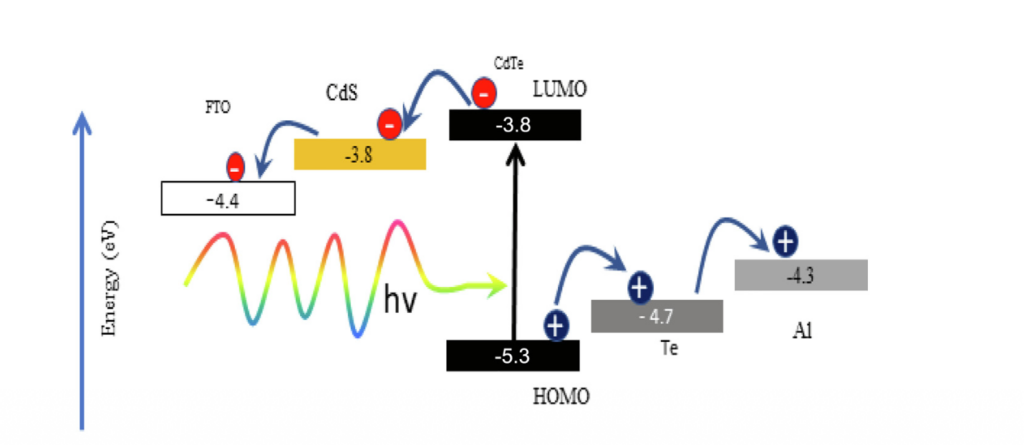
The magic happens at the interface between the CdTe absorber and the metal contact. For the cell to work efficiently, electrons need to flow smoothly from one material to the other. However, CdTe has a high “work function” (about 5.01 eV), meaning it holds onto its electrons tightly. Aluminum, a common and cheap contact material, has a much lower work function. This mismatch creates a sort of “potential energy barrier”—like a steep cliff that electrons have to jump over. This barrier causes what scientists call “Fermi energy pinning,” and it’s a major reason why the voltage (specifically, the open-circuit voltage, or Voc) of these cells isn’t as high as it could be.
The Clever Fix: A Tellurium Bridge
The team’s brilliant idea was to act as an intermediary. Instead of forcing the electrons to make a huge jump directly from the CdTe to the Aluminum, they built a bridge. They deposited an incredibly thin layer—just 40 nanometers—of pure Tellurium between the CdTe and the top Aluminum electrode.
Why Tellurium? It’s a perfect middleman. With a work function of 4.7 eV, it sits comfortably between CdTe (5.01 eV) and Aluminum (4.3 eV). This creates a gentle, stepped ramp for the electrons to travel along instead of a sharp, energy-sapping cliff. This “band alignment” helps to smooth out the interface, reducing defects and creating a clearer pathway for charge to flow.
Building a Better Solar Cell (In a Lab)
The team built their device using a method called thermal evaporation, which is essentially a high-tech way of vaporizing materials so they condense in thin, ultra-pure layers on a glass plate.
First, they deposited the n-type CdS layer onto a conductive glass slide. After annealing it at 350°C to crystallize it, they added the main p-type CdTe absorber layer at a higher temperature of 250°C. To form the crucial p-n junction where light is converted to electricity, they gave the whole thing a final bake at 450°C in open air. Then came the secret ingredient: that ultra-thin 40 nm layer of Tellurium. Finally, they added the top Aluminum contact to complete the circuit.
The Moment of Truth: Did It Work?
To see if their “voltage booster” worked, they put the cell through a series of tests.
First, they shone light on it and measured the output. The results were a fascinating mix of success and a reminder of how complex solar cell optimization can be. The good news was spectacular: their little cell generated an open-circuit voltage (Voc) of 0.7V (or 700mV). This is a significant jump compared to similar devices made without the tellurium layer. For instance, other research mentioned in the paper showed a cell without tellurium achieving only 418mV. This proved that their bridging layer was doing its job, allowing the cell to build up a much higher voltage.
However, the cell’s current (Isc) was quite low, which pulled down its overall efficiency to just 0.54% and gave it a poor “fill factor” of 28%. The team suspects that this is partly a side effect of their multi-layer structure. All those layers can introduce series resistance, which is like a narrow pipe that restricts the flow of current, even if the pressure (voltage) is high.
They also used a UV-Visible-NIR spectrometer to see how well the cell absorbed light. As expected, the CdTe layer did its job perfectly, absorbing strongly in the visible range and showing a transmittance of 48% in the near-infrared. A Tauc plot analysis confirmed that the CdTe had an ideal bandgap of 1.46 eV, perfectly tuned for absorbing sunlight.
A New Path Forward
So, is this a failure because the overall efficiency was low? Absolutely not. This research is a brilliant example of targeted problem-solving. The team set out to solve one specific problem—the voltage-draining energy barrier—and they succeeded.
So, is this a failure because the overall efficiency was low? Absolutely not. This research is a brilliant example of targeted problem-solving. The team set out to solve one specific problem—the voltage-draining energy barrier—and they succeeded. Imagine what they could achieve by combining their tellurium bridge with that standard treatment!
This work gives researchers a new tool and a new path forward. It shows that by carefully engineering the tiny interfaces inside a solar cell—those nanoscale junctions where materials meet—we can overcome fundamental physical barriers. It’s not just about the big, light-absorbing layers; sometimes, the thinnest layer in the middle holds the key to unlocking a much brighter, more powerful future for solar energy.
References:
- Wang, M., Li, X., & Wang, D. (2018). Eur. Phys. J. Appl. Phys.
- Kartopu, G., et al. (2014). Effect of window layer composition in Cd1-xZnxS/CdTe solar cells. Progress in Photovoltaics.
- Green, M. A., et al. (2017). Solar cell efficiency tables (version 50). Progress in Photovoltaics.
- Venkatesh, R., et al. (2020). Enhancement of open circuit voltage of CdTe solar cell. Materials Today: Proceedings.
- Schaffner, J., et al. (2011). Journal of Applied Physics.
- Yang, R., et al. (2014). RSC Advances.
- Lahewil, A. S. Z., et al. (2013). Procedia Engineering.
- Gaewdang, T., Wongcharoen, N., & Wongcharoen, T. (2012). Energy Procedia.
- Morales-Acevedo, A. (2006). Solar Energy.